
I visited Vita Smile Dental Clinic for implants and a smile makeover, and I couldn’t be happier with the outcome. Dr. Vildan and her team were warm, knowledgeable, and extremely detail-oriented. The clinic itself is spotless and modern, and they made sure I was comfortable every step of the way. They even helped with transportation and accommodation, which made the whole experience stress-free. My new smile looks amazing — I feel more confident than ever. If you're thinking about dental treatment in Turkey, Vita Smile is a fantastic choice. Thank you for everything!
General dentistry
Root Canal Treatment
Root canal treatment removes inflamed or infected pulp, the soft tissue inside a tooth, then cleans, disinfects, fills and seals the tooth so you can keep it. It is usually done under local anaesthetic over one or more appointments, and the tooth is then protected with a filling or a crown.
Published by Vita Smile Dental Clinic Sources (6)
Key takeaways
- Root canal treatment removes inflamed or infected pulp, then cleans, disinfects, fills and seals the tooth so it can be kept [1][2].
- It is usually done under local anaesthetic, over one or more appointments [1][2].
- Pain usually eases quickly: in a review of 72 studies, on average 81% of patients had pain before treatment, 40% a day after and 11% a week after [5].
- Across 14 studies, 86% to 93% of root-treated teeth were still in place 2 to 10 years later [4].
- The tooth needs a lasting filling or crown; a delayed restoration is one reason treatment fails [2][3].
At a glance
- Treats
- Inflamed or infected pulp
- Anaesthesia
- Usually local
- Appointments
- One or more, depending on the tooth
- Afterwards
- A filling or a crown
- Teeth in place at 2–10 years
- 86–93% in studies
The basics
What is root canal treatment?
Inside every tooth, beneath the hard outer layers, is the pulp: soft tissue that contains blood vessels, nerves and connective tissue [2]. It runs from the centre of the tooth down through the roots, in the root canals.
The pulp can become inflamed or infected through deep decay, repeated dental work on the same tooth, a faulty crown, or a crack or chip [2]. Gum disease can also lead to infection [1]. Left untreated, it can cause pain or an abscess [2].
Root canal treatment, also called endodontic treatment, removes the inflamed or infected pulp. The inside of the tooth is then carefully cleaned and disinfected, filled and sealed [2]. A fully developed tooth can survive without its pulp, because the tissues around it keep nourishing it [2].
The tooth then needs a filling or a dental crown [2]; a crown may be needed if it was badly infected [1].
Is it right for you?
Do you need a root canal?
Root canal treatment may be recommended when tooth pain comes from an infected tooth [1]. The signs below can point to an inflamed or infected pulp [2], but some have other causes, so a dentist confirms the diagnosis with an examination and an X-ray.
Signs you may need a root canal
When other options may be discussed
- Too little sound tooth is left to hold a lasting filling or crown
- A treated tooth has not healed: ask about retreatment or surgery [3]
- The tooth is to be extracted: plan how to replace it with an implant or a bridge [2]
- Gum disease is involved: it can infect the pulp too [1], so gum treatment is part of the plan
Step by step
How root canal treatment works
The NHS says treatment usually takes 2 or more appointments of 1 to 2 hours, sometimes longer [1]; the American Association of Endodontists says one or two, depending on the condition of the tooth [2].
-
Before you travel
Online consultation
Send a recent X-ray or photos of the tooth. A dentist replies with a personalised plan and a written quote, which is confirmed after the examination.
-
First appointment
Examination and X-ray
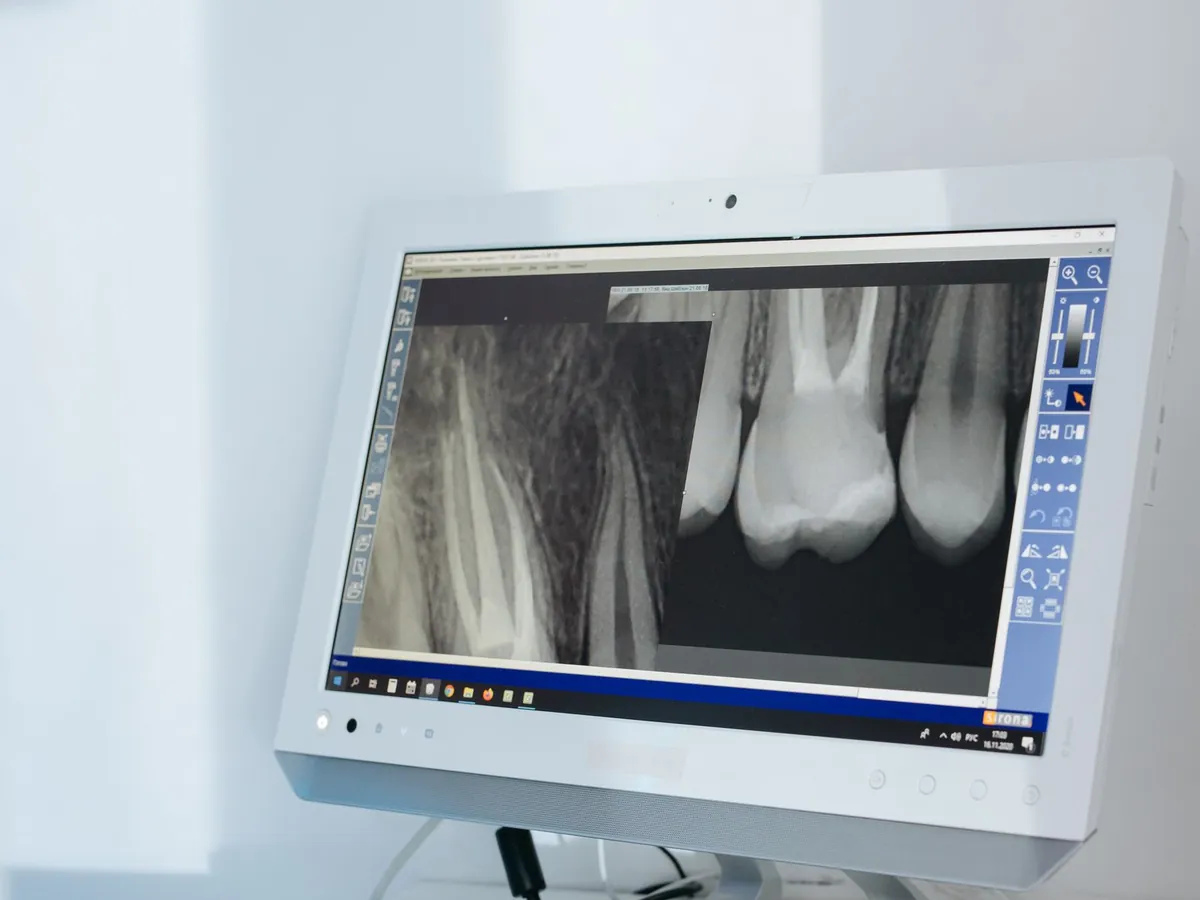
Your dentist examines the tooth and takes an X-ray to confirm the diagnosis and check that the tooth can be restored.
-
Treatment
Numbing and access
A local anaesthetic numbs the tooth, so you are awake but should not feel pain, and a small opening is made to reach the pulp [1].
-
Later
Follow-up
At check-ups, your dentist may take an X-ray to see how the area around the root is healing.
The number of appointments and the time between them depend on the tooth; your dentist confirms them after examining you.
Find out whether your tooth can be saved
Send a recent X-ray or a few photos. A dentist reviews them and replies with a personalised plan and a written quote, free of charge; the quote is confirmed after the examination.
Compare your options
Root canal treatment vs extraction
Root canal treatment keeps your own tooth: across 14 studies, 86% to 93% of root-treated teeth were still in place 2 to 10 years later [4]. A tooth that is extracted must be replaced with an implant or a bridge to restore chewing and stop the neighbouring teeth from shifting [2].
| Root canal treatment + filling or crown | Extraction + implant | Extraction + bridge | |
|---|---|---|---|
| Your own tooth | Kept | Removed | Removed |
| Surgery | No | Yes, to place the implant in the jawbone | No |
| Teeth beside it | Not affected | Left untouched | Usually crowned to hold the bridge |
| Healing before the final tooth | No bone healing needed | The implant must bond with the bone first | No bone healing needed |
Root canal treatment: AAE [2] and a review of 14 studies [4]. Implant healing times and study data: see dental implants.
Success and lifespan
How long does a tooth last after a root canal?
The American Association of Endodontists says that, with proper care, most root-treated teeth can last a lifetime [2]. Studies cover shorter periods: in a systematic review of 14 studies, 86% of root-treated teeth were still in place at 2 to 3 years, 93% at 4 to 5 years and 87% at 8 to 10 years [4].
The factor most strongly linked with survival was a crown after treatment, followed by neighbouring teeth touching on both sides, the tooth not holding a bridge or denture, and it not being a molar [4]. Still, the only randomised trial comparing crowns with fillings on root-filled teeth was small, and a Cochrane review found too little evidence to say which is better [6]. The choice depends on how much of the tooth is left [6], so your dentist decides after examining it.
Before you decide
Pain, risks and retreatment
Root canal treatment is well studied [4][5], but it is not risk-free:
- Pain during treatmentA local anaesthetic is used [1], but in studies extra anaesthetic injections were often needed [5].
- Soreness afterwardsThe area may feel swollen and sore, and should get better in a couple of weeks [1]. In a review of 72 studies, the average share of patients in pain fell from 81% before treatment to 40% after a day and 11% after a week [5].
- Missed canalsNarrow, curved or extra canals that are not treated can stop the tooth from healing [3].
- A delayed restorationPutting off the crown or filling is one reason treatment fails [3].
If a treated tooth does not heal, or hurts again months or years later, it may be treated again: the tooth is reopened, the old filling removed, the canals checked for extra canals or new infection, then cleaned and refilled [3]. Surgery at the root tip and extraction with an implant are other options [3].
From our dentist
“Two questions guide me with a painful tooth: can it be saved, and can it be restored well afterwards? A root canal is only half of the treatment; the filling or crown that follows protects the tooth, so I plan both before I start. I show you what I see on the X-ray and go through every option, extraction included. If you are travelling, leave time in your plan for the final restoration, and take your X-rays home for your own dentist.”
Treatment abroad
Root canal treatment in Turkey: choosing a clinic
In Istanbul the treatment follows the same steps as at home; what differs is how much time you have. Plan for the final filling or crown too, because a delayed restoration is one reason treatment fails [3].
Before you book, ask:
- How many appointments does my tooth need, and will the final filling or crown be fitted before I fly home?
- How is the tooth kept clean and dry during treatment, for example with a rubber dam?
- Will I receive copies of my X-rays, including one taken after the canals are filled, for my dentist at home?
- What happens if the tooth still hurts once I am home?
Root canal treatment pages at Vita Smile are reviewed by Dr. Hediye Nur Uygun, a general dentist whose work includes root canal treatment. You can meet our dentists or start with a free online consultation.
Questions
Root canal treatment: frequently asked questions
Can't find your answer? Our coordinators are happy to help on WhatsApp.
Ask on WhatsAppHow much would a root canal cost in Turkey?
It depends on the tooth, whether it is a retreatment, and whether a filling or a crown follows. After a free online assessment you receive a written quote, confirmed after the examination; check that it includes the final restoration [2].
Is it safe to go to Turkey to get your teeth done?
It can be, if the clinic is licensed, you are examined with an X-ray first, and the final filling or crown fits into your stay; a delayed restoration is one reason treatment fails [3].
Is root canal treatment painful?
It is done under local anaesthetic, so you should not feel pain during it [1]; the American Association of Endodontists says it is not more painful than a filling [2]. In studies, pain dropped within a day and reached minimal levels within a week [5].
How many appointments does a root canal need?
One or two, depending on the tooth, says the American Association of Endodontists [2]; the NHS says usually 2 or more [1]. Your dentist confirms the number after the examination.
What is the success rate of root canal treatment?
Studies usually measure whether the tooth is still in place: in a review of 14 studies, 86% to 93% of root-treated teeth survived 2 to 10 years [4].
Is it better to extract the tooth or have a root canal?
Root canal treatment lets you keep your own tooth [2]. An extracted tooth must be replaced with an implant or a bridge to restore chewing and stop the neighbouring teeth from shifting [2].
What should you not do after a root canal?
Do not put off the final filling or crown, as a delayed restoration is one reason treatment fails [3]. Until then, ask how carefully to chew on the tooth, and call your dentist if pain or swelling increases.
What our patients say
Read what our patients say about us on Google and Trustpilot.
Free consultation
Free initial consultation
Leave your details and a treatment coordinator will contact you to arrange your free online consultation.
- We get in touchWe reply to you on WhatsApp.
- You share photos or an X-rayA dentist reviews them before your consultation.
- You receive your plan & quoteItemised and free, with no obligation to book.
Sources
Studies and patient guides this page is based on.
- [1] Root canal treatment — NHS (page last reviewed 3 October 2025) · nhs.uk
- [2] What is a root canal? — American Association of Endodontists · aae.org
- [3] Endodontic retreatment — American Association of Endodontists · aae.org
- [4] Ng YL, Mann V, Gulabivala K. Tooth survival following non-surgical root canal treatment: a systematic review of the literature. International Endodontic Journal, 2010 · doi.org
- [5] Pak JG, White SN. Pain prevalence and severity before, during, and after root canal treatment: a systematic review. Journal of Endodontics, 2011 · doi.org
- [6] Sequeira-Byron P, Fedorowicz Z, Carter B, Nasser M, Alrowaili EF. Single crowns versus conventional fillings for the restoration of root-filled teeth. Cochrane Database of Systematic Reviews, 2015 · doi.org